
Blog

CISA’s Guide to OT Network Segmentation

🛡️Why Network Segmentation Matters

Network segmentation is a cornerstone of OT cybersecurity. It involves dividing a network into isolated, secure zones—either physically or virtually—each acting as a self-contained subnetwork. This approach:

  • Reduces risk
  • Enhances control
  • Prevents lateral movement in the event of a breach

The Cybersecurity and Infrastructure Security Agency (CISA) emphasizes the importance of segmentation and provides a clear, actionable framework for its implementation—especially for critical infrastructure environments.

Top 5 Benefits of Network Segmentation

  1. Threat Containment: Compromised systems are confined within their segment, preventing wider disruption.
  2. Smaller Attack Surface: Limiting inter-zone communication reduces paths for attackers to reach sensitive assets.
  3. Protection of Critical Assets: High-value systems like DCSs, PLCs, HMIs, and control servers are isolated from less secure IT zones.
  4. Improved Monitoring: Smaller zones allow for more precise anomaly detection and event tracking.
  5. Compliance Enablement: Helps meet requirements in frameworks like ISA/IEC 62443, which mandate segmentation as a baseline control.

Key Components of an Effective Segmentation Strategy

1. Define and Group Zones

Organize assets by function and risk level. Typical OT zones include:

  • Control Zone: PLCs, DCS, SCADA, most critical layer.
  • Historian Zone: Operational data aggregation.
  • MES Zone: Operational-to-enterprise handoff.
  • Remote Access Zone: For secure third-party or vendor access.
  • Enterprise IT Zone: Business apps and office systems.

2. Establish Secure Conduits Between Zones

  • Strict Communication Rules: Permit only essential traffic between zones, with defined protocols and endpoints.
  • Firewalls with ACLs: Use industrial firewalls and Access Control Lists to strictly manage inter-zone traffic.
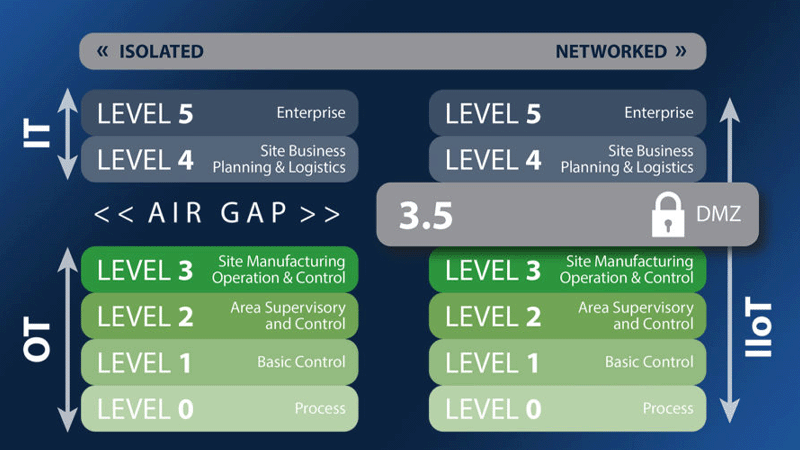
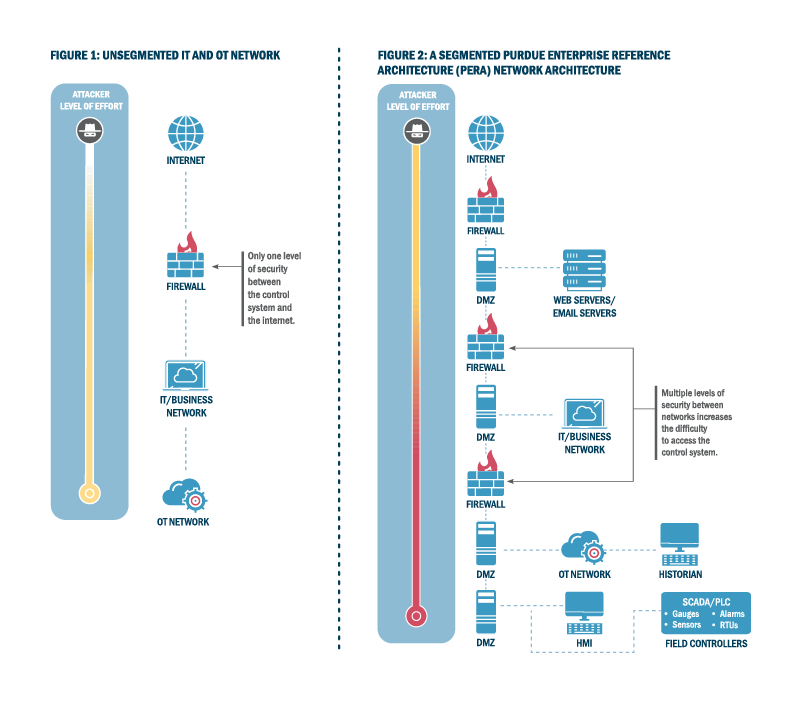
  • DMZ Deployment: A DMZ acts as a secure proxy zone between IT and OT, preventing direct access while enabling controlled data exchange.

What is a Demilitarized Zone (DMZ)?

A secure buffer that separates critical OT systems from external or enterprise networks.

3. Test, Monitor, and Maintain Continuously

  • Validate Controls: Post-deployment testing ensures segmentation functions correctly without disrupting operations.
  • Continuous Monitoring: Track traffic flows and flag deviations or unauthorized access attempts.
  • Ongoing Review: Update policies as new assets or threats arise.

🏆 The Champion Advantage

Effective segmentation requires more than IT knowledge, it demands a deep understanding of industrial processes. That’s where Champion Technology Services excels.

We deliver segmentation strategies that:

  • Protect operations without disrupting uptime
  • Align with CISA guidance and industry specific standards
  • Bridge IT security best practices with OT realities

We combine cybersecurity leadership with control system expertise to design and implement resilient, scalable, and compliant network architectures for critical infrastructure environments.

CISA Recommendations

  • Segment high-value assets into isolated, high-security zones.
  • Use firewalls with specific access control rules.
  • Create a DMZ for critical cross-domain operations.
  • Limit access to DMZ devices through defined user and device lists.
  • Restrict data traffic from OT to IT, particularly for remote access.
Click to see full size.


Let's collaborate.

Schedule a no-cost consultation today.



solution brief

Network Segmentation


More Posts

Read More
Project Brief

Industrial Data Center Upgrade

  • The Challenge

Legacy data center hardware had reached end-of-life, limiting system reliability, scalability, and vendor support options.

Obsolete Windows environments prevented the application of critical patches and updates, impacting compliance and system stability.

Outdated versions of FactoryTalk and historian software introduced performance bottlenecks and integration challenges with modern platforms.

fragmented domain and workgroup configuration made it difficult to enforce consistent user policies or manage authentication centrally.

Limited VLAN segmentation reduced network visibility, increased broadcast domain congestion, and created barriers to secure zone management.

The absence of high-availability mechanisms and VM mobility increased risk during maintenance windows and system transitions.

The migration needed to occur without interrupting operations, requiring a carefully sequenced cutover plan and parallel runtime verification.

  • Our Solution

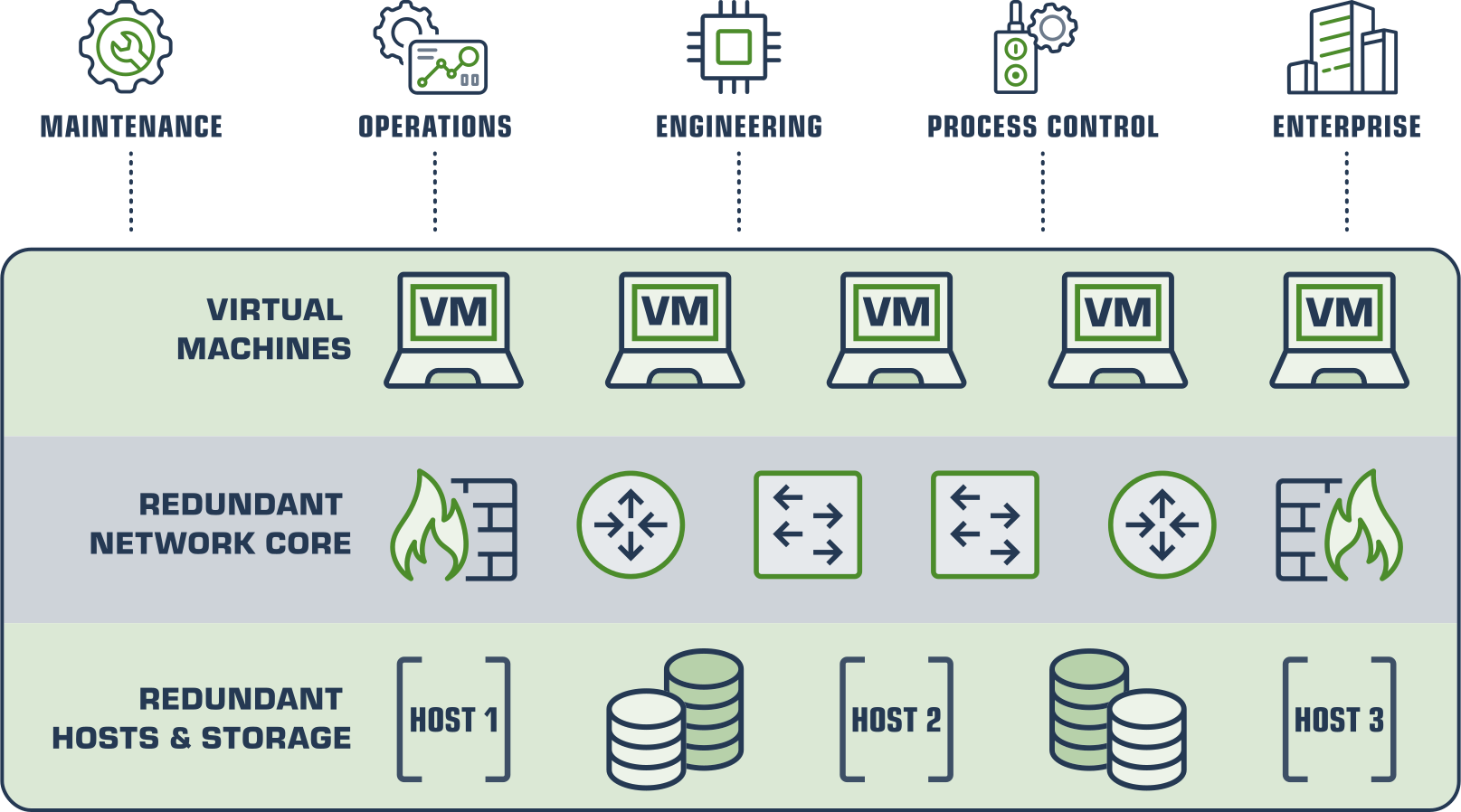
Both data center environments were rebuilt with fully virtualized, high-availability platforms. Core control system applications, historian nodes, and Windows services were migrated to domain-managed virtual machines for greater scalability and centralized control.

Switching infrastructure was upgraded to support segmented VLANs for management, storage, and control traffic. Routed failover between sites provided redundancy and improved network performance.

OT applications including FactoryTalk View SE, Linx, Alarm & Event, and Historian services were upgraded to current versions. Engineering and operator workstations were refreshed with pre-configured toolsets for faster deployment and user readiness.

A structured deployment approach included Factory Acceptance Testing (FAT), parallel HMI validation, and a staged cutover. Snapshot backups and rollback procedures ensured system continuity throughout.

  • Project Timeline: 6 Months
  • The Results

The modernized OT systems delivered key advantages. Redundant systems ensured uptime and operational continuity, while network segmentation and supported platforms strengthened cybersecurity. Centralized control simplified management, and modern infrastructure provided fast recovery and failover.

Sed egestas, ante et vulputate volutpat, eros pede semper est, vitae luctus metus libero eu augue. Morbi purus libero, faucibus adipiscing, commodo quis, gravida id, est. Sed lectus. Praesent elementum hendrerit tortor. Sed semper lorem at felis. Vestibulum volutpat, lacus a ultrices sagittis, mi neque euismod dui, eu pulvinar nunc sapien ornare nisl. Phasellus pede arcu, dapibus eu, fermentum et, dapibus sed, urna.

  • The Champion Advantage
Seamless Integration

A unified solution across virtualization, networking, and software eliminated the need for multiple vendors.

Client-Centered Execution and Support

Staged cutover, clear documentation, and on-site training ensured a smooth transition with minimal disruption.

Scalable and Future-Ready

The upgraded infrastructure supports digital growth, remote access, and enhanced OT visibility.

Smarter Commissioning, Faster Execution

Champion’s risk-informed approach, with FAT, SAT, and operator validation, enabled efficient deployment and handoff.

Sed egestas, ante et vulputate volutpat, eros pede semper est, vitae luctus metus libero eu augue. Morbi purus libero, faucibus adipiscing, commodo quis, gravida id, est. Sed lectus. Praesent elementum hendrerit tortor. Sed semper lorem at felis. Vestibulum volutpat, lacus a ultrices sagittis, mi neque euismod dui, eu pulvinar nunc sapien ornare nisl. Phasellus pede arcu, dapibus eu, fermentum et, dapibus sed, urna.

Ready to elevate your operations?

article

Securing Legacy OT Systems

solution brief

Disaster Recovery

Read More
Blog

Enhance OT Security with Network Segmentation

In today's increasingly connected operational environments, network segmentation is a foundational pillar for cybersecurity, performance, and system reliability. For industrial facilities managing legacy assets, segmentation isn't just an IT best practice, it's a business-critical strategy.

What is Network Segmentation?

Network segmentation involves dividing a network into smaller, isolated segments (or subnets), each with its own access controls and security measures. This approach:

  • Minimizes the attack surface
  • Restricts lateral movement by threat actors
  • Prevents malware from spreading across the network

6 Key Strategies for Effective Segmentation

1. IT/OT Alignment 🤝

Ensure collaboration between IT and OT teams from the outset. Joint planning, training, and awareness initiatives build shared ownership and improve execution.

2. Identify Critical Assets 🔍

Prioritize protection by identifying which systems are most critical to operations. This enables a phased segmentation approach that minimizes disruption.

3. Network Mapping 🗺️

Visualizing all connected entities reveals data flows, hidden vulnerabilities, and monitoring blind spots—essential for informed segmentation planning.

4. Define Network Zones 🧱

Group systems with similar security requirements into zones, and enforce strict rules for how data moves between them. This zoning model forms the backbone of OT segmentation.

5. Implementation ⚙️

Roll out segmentation in phases to minimize operational risk. Closely monitor performance throughout the rollout to identify and resolve unforeseen issues early.

6. Monitor and Maintain 📈

Ongoing monitoring and regular audits ensure the segmentation strategy adapts to evolving threats. Update protocols and configurations as your network grows or changes.

The Takeaway

As cyber threats grow more sophisticated, network segmentation is no longer optional—it’s foundational. By creating controlled, isolated zones within your OT network, you enhance system protection, simplify compliance, and future-proof your operations for digital transformation.

Let's collaborate.

Schedule a no-cost consultation today.


solution brief

System Hardening


More Posts

Read More
Blog

Cisco Catalyst 2960 End of Life: What It Means for OT Environments

🚨 Cisco Catalyst 2960 Switches: End of Life & What It Means for OT Systems

If you’re operating industrial control systems, chances are Cisco Catalyst 2960 switches are buried somewhere in your infrastructure. These reliable workhorses have long supported OT environments—but Cisco has officially announced their End of Life (EOL).

For facilities relying on these switches for SCADA, PLC, or DCS networks, the implications are serious:
🔒 Increased cybersecurity risk
⚠️ Unplanned downtime
💸 Rising replacement costs


❓What Does EOL Mean for Catalyst 2960?

Cisco’s EOL designation means that the Catalyst 2960 switches will:

  • ❌No longer receive software updates or critical security patches 
  • 📞No longer be supported under standard Cisco TAC
  • 🧩Become harder (and pricier) to source due to limited hardware availability

In OT environments, this creates major concerns such as: 

  • 🔐Incompatibility with modern security standards 
  • 🔧Lack of support during failures or cyber incidents 
  • 🛑Disruptive outages caused by aging hardware 
  • 🛑Growing attack surface due to outdated firmware 

⚠️The Risk of Doing Nothing

Sure, the 2960 might still “work”…
But in regulated or mission-critical facilities, relying on unsupported hardware is a liability.
These switches are often deeply integrated—meaning failure could affect production, safety, and compliance.

🛠️Champion’s OT Mitigation Strategy

Our team brings deep domain expertise in ICS networks and zero-disruption migration planning. Our strategy is built for operational continuity:

1️⃣OT Network Discovery

Full network audit to locate 2960s, identify dependencies, and assess criticality.

2️⃣Lifecycle and Risk Analysis

Prioritization using OEM lifecycle data, operational impact, and supportability.

3️⃣Replacement Roadmap

Phased rollout using industrial-grade, Cisco-approved switches ensuring: 

  • Compatibility with your OT protocols 
  • Segmentation and VLAN design 
  • Ruggedization for harsh environments

4️⃣Secure Network Design and Hardening

We go beyond replacement to modernize your OT network:

  • ISA/IEC 62443 alignment
  • Security Zone segmentation
  • VLAN/firewall rules
  • Zero Trust principles

5️⃣Project Execution and Commissioning

Planned and executed by our experienced OT teams during low-risk windows, minimizing downtime and maintaining system integrity.

6️⃣Ongoing Support

Post-upgrade monitoring, health checks, and managed support for sustained reliability.

🏆Why Champion?

With decades of control system integration experience, we’ve successfully delivered secure migrations across:

  • 🛢️ Oil & Gas
  • 🧪 Chemicals
  • ⚡ Utilities
  • 🏭 Manufacturing
  • 🚢 Marine & Terminals

In these environments, downtime isn’t an option—and safety is non-negotiable.

💡Final Thoughts

EOL for the Catalyst 2960 isn’t just a hardware sunset. It’s a strategic opportunity to strengthen your OT network’s security, resilience, and performance.

Let’s modernize your network—on your terms.

Let's collaborate.

Schedule a no-cost consultation today.


Blog

Network Segmentation to Enhance OT Cybersecurity


More Posts

Read More
Blog

3 Reasons an “Air Gap” is Not Good Enough

Is an Air-Gap “Good Enough” to keep your Industrial Control System secure? Short answer: No. Here’s why…

“Security by isolation” or air-gapping previously worked in Operational Technology (OT) environments when OT and IT were completely isolated from one another. Many older systems based on PLC’s and SCADA were built without cybersecurity in mind. OT and IT are now converging as organizations embrace the digital transformation, and security experts are now declaring the air gap dead as security by isolation is not a long-term solution for protecting OT assets.

Air Gapping an OT system has very limited value in today’s constant technological advances. It can no longer be used as a sole security solution in the long term for three reasons:

  • It causes organizations to miss out on valuable data.
  • It is more costly and difficult for maintenance and repairs.
  • It is more prone to security breaches than a “connected” OT system.

Missing out on Data

While air-gapped OT systems can minimize risks, organizations are not able to benefit from the highly valuable data these systems generate. Data analyzed in real time can provide business intelligence to cut costs, reduce downtime, and improve efficiency. These opportunity costs outweigh air-gapping as a viable cyber security measure.

Higher Maintenance Costs

Maintaining air-gapped OT systems are more expensive and difficult because the engineering tools of a connected system cannot be used to perform routine maintenance or troubleshoot problems. It also limits the system from secure remote support by technical experts. Without remote access, facilities experience higher support costs and increased downtime. The reality is that even a properly air-gapped system is not completely protected; Every system is a potential breach target, and even air-gapped systems can be infiltrated. Organizations must engage in active monitoring and security measures to mitigate the risks.

Reduced Security

Air Gaps can be physically breached by a third-party networked laptop, USB drive, removable media, smartphone, or other devices. Allowing OT systems to connect with these devices creates vulnerabilities that air gapping cannot protect against. Air gapping makes it difficult for users to move back and forth between the air-gapped device and network-connected devices. For ease of use, an individual may use an unsecure USB drive to transfer data which could compromise an air-gapped system.

OT infrastructure is only as secure as the user operating the devices. An openly accessible USB port can serve as an entry route for malware. Smartphones provide another convenient route to cross air gaps when switched to Wi-Fi hotspot mode. The Wi-Fi hotspots can also be used as an entry point by hackers or those with ill intentions.

90+% of randomly found USB drives are picked up by the casual person and more than half are plugged into a PC.
Source: Kapersky

Why your OT control systems can’t afford cybersecurity shortcuts:

OT cyber-attacks are more dangerous in nature. An OT attack can pose risks to operational and safety systems, employees, plant, and environment. Because the outcome of an OT cyber-attack is more catastrophic, it is essential that organizations prioritize cybersecurity. While air gapping provides some security, it is not the best option to select in the competitive marketplace.

Air gapped control systems are also more vulnerable because they don’t receive the latest Windows security patches easily, therefore are usually neglected. As new virus threats emerge, the OT system will likely be unprotected, unlike its Enterprise counterpart.

We must accept the fact that air gapping as a security control is no longer a valid option. IT and OT will continue to converge leaving air gapping to be useless. Facilities should take advantage of the opportunities from integrated technologies to reduce costs and downtime while improving efficiency. While doing so, they must prioritize OT security to lessen the risk and still capitalize on the advantages of a connected IT and OT world.

Let's collaborate.

Schedule a no-cost consultation today.


more on our website

Industrial Cybersecurity


More Posts

Read More
Blog

Microsoft Support for Windows 7 and Server 2008 Has Ended

What does this mean for industrial users?

Is your facility using Windows 7 or Windows Server 2008 for its industrial control systems? If so, you should know that beginning January 14, 2020, Microsoft will no longer be providing security updates or support for these products. This means your systems will become increasingly more vulnerable to security risks.

Can your operation afford the uncertainty of production downtime, proprietary information loss, or even a full system failure? Stay current and migrate to Windows 10, and the latest release of Windows Server. This will ensure you continue receiving the latest security patches necessary for maximum uptime.

Not sure how to migrate?

Champion’s team of Engineers and Cybersecurity Experts have you covered with options that work best for your facility’s needs. Trained in the latest ISA/IEC 62443 and NIST standards for industrial cybersecurity, our specialists have the certifications and real world application experience to recommend the best option for you. We can provide you with system assessments, implementation recommendations based on industry best practices, maintain the integrity of your control system, and lower the exposure to future threats. To read more about Windows 7 and Windows Server end of support, visit Microsoft.com.

Let's collaborate.

Schedule a no-cost consultation today.


solution brief

DCOM Hardening


Read More