
Blog

Compliance Assessments Made Practical

Navigating today’s cybersecurity regulations can feel overwhelming, especially in industrial environments where operational realities add complexity.

A compliance assessment cuts through that noise by answering a critical question: are we truly meeting our regulatory requirements?

It’s not just about avoiding fines. It’s about building a structured, auditable security program that aligns with recognized standards and stands up to real-world scrutiny.

A compliance assessment evaluates your organization’s alignment with established frameworks such as ISA/IEC 62443, NIST Cybersecurity Framework (including ICS guidance), and NERC CIP. It compares your existing controls, processes, and documentation against required standards, clearly identifying where you meet expectations and where gaps remain.

Why It Matters in Industrial OT

For industrial organizations, compliance is no longer optional, it’s operationally critical.
Cyber incidents in OT environments don’t just impact data, they can disrupt production, impact safety, and create regulatory exposure. At the same time, evolving mandates (such as MTSA updates and sector-specific regulations) are increasing expectations for demonstrable cybersecurity maturity.

A compliance assessment ensures you are not only prepared for audits but are also building a defensible, resilient security posture. It shifts compliance from a checkbox exercise to a sustainable operational capability.

Key Components

Policy and Documentation Review

We evaluate your existing policies, procedures, and supporting documentation, from incident response to asset management. The goal is to ensure documentation is not only present, but accurate, actionable, and aligned with the target framework.

Technical Control Evaluation

Compliance doesn’t stop at documentation. We validate that technical controls are implemented and functioning as intended, reviewing segmentation, access controls, firewall configurations, and system hardening within the realities of an OT environment.

Regulatory Gap Identification

We perform a structured gap analysis to identify where your current posture diverges from required standards. The output is a clear, actionable roadmap, not just a list of deficiencies.

Remediation Planning

Closing gaps requires more than recommendations. We work alongside your team to prioritize actions based on risk, operational impact, and compliance urgency, balancing security improvements with production continuity.

Making Compliance Practical in OT

Compliance in OT isn’t always straightforward. Legacy infrastructure, uptime requirements, and safety considerations make traditional IT-driven approaches difficult to apply in practice.
A successful compliance program must account for how industrial systems actually operate, where changes must be carefully planned, validated, and executed without disrupting production.
This is where experience matters. Translating regulatory requirements into real-world implementation, while maintaining operational continuity, is what ultimately determines success.

Key Takeaway 

A compliance assessment provides clarity in a complex regulatory landscape. It establishes a defensible baseline, identifies what matters most, and creates a path forward.

Done right, it’s not just about passing an audit, it’s about building a program that is repeatable, sustainable, and aligned with how industrial operations actually run.

  • The Champion Advantage

Champion brings a practical, execution-focused approach to OT compliance, bridging the gap between regulatory requirements and operational reality.

OT-Native Expertise

Deep experience across control systems, networks, and industrial processes ensures recommendations are grounded in real operations. 

Operationally Safe Execution

Solutions are designed and validated with uptime, safety, and production constraints in mind. 

End-to-End Support

From assessment through remediation and ongoing support, we stay engaged to ensure outcomes—not just deliverables. 

Aligned with Modernization Efforts

Compliance is integrated into broader initiatives such as system upgrades, network redesigns, and cybersecurity improvements.

This approach is demonstrated in real-world projects, such as control system upgrades and network modernization executed without operational disruption, where compliance, reliability, and performance are advanced together.


Ready to learn more? Contact us today to schedule a no-cost consultation.

We empower our clients to build safe, sustainable operations by delivering comprehensive Operational Technology (OT) solutions. From concept to implementation and beyond– we'll be there every step of the way.

Solution Brief

MTSA Cybersecurity Compliance


Let's collaborate.

Schedule a no-cost consultation today.


More Posts

Read More
Blog

OT Vulnerability Assessments: Turning Visibility into Action

While a gap or risk assessment provides a strategic view of your overall security posture, an OT vulnerability assessment delivers a granular, technical snapshot of where your systems are most exposed. It is a proactive, systematic process that combines OT-aware automated tools with expert manual analysis to identify, classify, and prioritize known vulnerabilities across networks, assets, and applications, such as unpatched software, insecure configurations, and legacy design flaws, that could be exploited by a malicious actor.

The goal is simple but critical: find and address vulnerabilities before they are leveraged against your operations.

Why It Matters

In industrial environments, vulnerability assessments are a core component of proactive asset and security management, not just a cybersecurity exercise. Unlike IT systems, OT assets often run continuously, support safety-critical processes, and may rely on legacy hardware or operating systems that cannot be easily patched or replaced.

A thorough OT vulnerability assessment goes beyond software flaws to uncover: 

  • Misconfigurations that weaken defense-in-depth 
  • Unsupported or unpatched systems increasing cyber and operational risk
  • Insecure access pathways that could lead to a cyber-physical incident 

Left unaddressed, these vulnerabilities increase the likelihood of unplanned downtime, safety incidents, and loss of operational control.

Key Components

Automated Scanning 

Specialized, non-intrusive OT-aware tools are used to identify known vulnerabilities across networks, devices, and applications, such as missing patches, insecure services, or default credentials. Scanning is carefully planned and executed to avoid disrupting sensitive control processes.

Manual Review 

Expert engineers perform in-depth reviews of system configurations, network architectures, access controls, and operational practices. This human analysis is essential in OT environments, where context matters and automated tools alone may overlook logical design flaws or risk-creating exceptions.

Physical Security Inspection 

In OT environments, cyber risk often starts with physical access, intentional or accidental. On-site inspections identify physical exposure points such as unsecured cabinets, control panels, removable media access, or network drops, making physical security a critical component of a true OT vulnerability assessment.

Reporting and Prioritization 

Findings are documented in a clear, actionable report that:

  • Assigns severity based on operational and safety impact 
  • Differentiates between vulnerabilities that can be patched, mitigated, or accepted
  • Provides practical remediation guidance aligned with plant constraints 

Results are prioritized collaboratively so teams can focus first on vulnerabilities that pose the greatest risk to safety, reliability, and uptime.

Key Takeaway 

An OT vulnerability assessment is the operational backbone of proactive security. It transforms abstract risk into a prioritized, actionable list of technical and physical weaknesses that can be addressed through targeted remediation. By systematically reducing exposure, organizations shrink their attack surface, improve resilience, and make industrial systems far more difficult to compromise, without disrupting operations.

  • The Champion Advantage

Champion’s OT vulnerability assessments are designed specifically for live, safety-critical industrial environments, where uptime, process integrity, and operator confidence matter as much as cybersecurity.

OT-First, Operations-Aware Execution

Our assessments are led by engineers with deep control system and plant operations experience, not IT-only security teams, ensuring vulnerabilities are identified without disrupting production.

Contextual Risk Prioritization

Vulnerabilities are evaluated based on real operational impact, safety, reliability, environmental risk, and downtime, not just generic CVSS scores.

Actionable, Realistic Remediation Guidance

Our recommendations reflect operational constraints such as patch windows, vendor support limitations, and system life cycle considerations, providing practical mitigation paths, not theoretical fixes.

Safe, Non-Intrusive Assessment Methods

We use OT-approved tools and carefully planned techniques tailored to industrial protocols and legacy systems, minimizing risk to sensitive processes and equipment.

Integrated Cyber-Physical Perspective

By combining network analysis, configuration review, and physical security inspection, we uncover attack paths that purely digital assessments often miss.

Built to Feed the Broader OT Security Roadmap

Vulnerability assessment results seamlessly support gap assessments, risk analysis, segmentation design, and long-term modernization planning, turning findings into sustained improvement.

With Champion, OT vulnerability assessments are not a one-time scan, they are a disciplined, operations-safe process that protects what matters most: safe and reliable operations.

Secure the Foundation, Modernize with Confidence

Modernizing on top of hidden security flaws is a recipe for future downtime. A Vulnerability Assessment provides a technical "deep dive" into your assets before you start major modernization project like:

  • On-Process Migrations
  • OT Data Center Development
  • Virtualization
  • Network Redesigns

By purging known vulnerabilities early, you ensure your new system is built on a clean, stable, and secure foundation.

Let's collaborate.

Schedule a no-cost consultation today.


Article

A Guide to Cybersecurity Assessments


More Posts

Read More
Blog

Gap Assessments: Your Security Starting Point

OT Cybersecurity Gap Assessments: The First Step Toward a Safer, More Reliable Operation 

For industrial organizations, building a mature cybersecurity posture starts with clarity. You can’t improve what you can’t see, especially in complex OT environments where aging systems, undocumented devices, and day-to-day operational pressures create blind spots. 

A gap assessment gives OT teams that clarity. By comparing your current controls, policies, and procedures against frameworks like NIST CSFISA/IEC 62443, or NERC CIP, it delivers a clear, prioritized roadmap tailored to your operations. For operators, technicians, and engineers, the impact is direct: improved uptime, reliability, safety, and long-term system health. 

What an OT Gap Assessment Is and Why It Matters 

A gap assessment evaluates your OT environment against a defined target state built on industry standards, regulatory requirements, and operational needs. It enables you to understand: 

  • Your true security posture 
  • Operational weaknesses tied to legacy systems or manual processes 
  • Misalignments between policy and reality 
  • The highest-impact improvements to reduce risk 

OT systems can’t simply be rebooted or patched whenever convenient. Every change must protect safety, reliability, and process continuity and a gap assessment ensures your controls and processes support those realities. 

For OT personnel, the benefits include: 

  • Better visibility into aging and undocumented assets 
  • Reduced troubleshooting time 
  • Increased confidence in system reliability 
  • Early insight into modernization and lifecycle requirements 
  • Stronger justification for budget and resource planning 

A gap assessment shifts the conversation from “Is our firewall configured correctly?” to “Do our systems and processes support long-term operational health and safety?”

What to Expect During the Assessment 

The process is collaborative and designed to minimize operational disruption. It focuses on how your facility actually works, not just what’s documented. 

Typical activities include: 

  • Documentation Review: Architecture diagrams, control system configurations, network designs, and backup procedures 
  • Field Validation: Walkdowns in control rooms, server cabinets, and field panels to verify what actually exists 
  • Workflow & Access Review: Operator practices, account usage, change management, and legacy “tribal knowledge” 

The goal is a clear, accurate understanding of your current environment. 

Key Components of an OT Gap Assessment 

1. Baseline Evaluation 

We document how systems are designed and operated today, capturing real-world conditions such as unsupported operating systems, end-of-life controllers, unmanaged network devices, vendor-installed assets, and manual processes that introduce operational risk. 

2. Target State Definition 

Together, we establish a realistic target state aligned with NIST CSF, ISA/IEC 62443, regulatory obligations, and your operational priorities. 

3. Gap Identification 

We highlight where your environment diverges from best practices across segmentation, access control, backups, patching, monitoring, governance, and system lifecycle practices and explain what each gap means for uptime, safety, and reliability. 

4. Remediation Planning 

We build a prioritized roadmap that accounts for downtime windows, staffing, investment needs, and alignment with ongoing modernization efforts. Every recommendation is practical for a 24/7 industrial environment. 

What We Typically Find and Why It Matters 

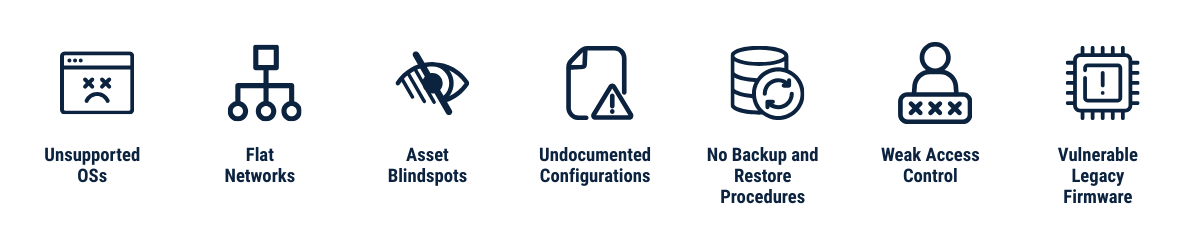
Across assessments, common issues include: 

  • Unsupported or unpatched operating systems 
  • Flat networks with limited segmentation 
  • Outdated or incomplete asset inventories 
  • Poorly documented configurations 
  • Lack of formal backup/restore procedures 
  • Shared accounts or unmanaged access 
  • Legacy firmware with known vulnerabilities 

These conditions are typical in long-lived OT systems. A gap assessment simply makes them visible so improvements can be planned objectively and cost-effectively. 

Key Takeaway 

A gap assessment is the foundational step toward building a resilient OT cybersecurity and operational program. It provides clarity, actionable priorities, and a realistic roadmap grounded in your operational reality. 

For OT end users, it delivers what matters most: safer operations, fewer disruptions, and a more reliable control system environment. 

🏆The Champion Advantage

We don't just assess, we also implement remediations. Many firms can identify gaps, Champion closes them. 

Deep OT Expertise 

Our engineers understand legacy and modern control systems across PLC, DCS, SCADA, networking, virtualization, and system architecture. 

From Findings to Implementation 

We don’t stop at recommendations. Our teams execute the remediation work, whether that means: 

  • Segmenting networks 
  • Deploying firewalls or access control improvements 
  • Updating or migrating control systems 
  • Virtualizing servers 
  • Implementing backup/DR solutions 
  • Replacing outdated PLCs or infrastructure 
  • Supporting DCS modernization or on-process migrations 

You get a partner who can take your roadmap from paper to production. 

Proven in Live Industrial Environments 

Our methodology has been refined across various critical infrastructure industries, without jeopardizing operational continuity. 

Integrated Support 

We work closely with operators, engineers, and IT/OT teams to ensure every improvement aligns with real workflows, staffing, and maintenance constraints. 

Your assessment becomes a fully supported execution plan, not homework. 

How Gap Assessments Support Modernization 

Many organizations begin with a gap assessment before embarking on broader modernization efforts like: 

  • DCS upgrades 
  • Virtualization 
  • On-process migrations 
  • Network redesigns 
  • OT data center development 

By identifying aging assets, unsupported software, and high-risk configurations early, the assessment ensures modernization plans are cleaner, safer, and more cost-effective.

Let's collaborate.

Schedule a no-cost consultation today.


Article

A Guide to Cybersecurity Assessments


More Posts

Read More
Project Brief

Multi-Site OT Cybersecurity Assessment

  • The Challenge

The client sought to gain deeper visibility and control across multiple industrial facilities. While each facility had its own systems and processes in place, there was a clear opportunity to enhance standardization, improve documentation, and align cybersecurity practices across the broader OT environment.

Key focus areas included:

  • Establishing a consistent view of OT assets across all facilities
  • Improving clarity around existing network architectures
  • Identifying opportunities to strengthen and unify cybersecurity policies and controls

With this assessment, the client aimed to lay a stronger foundation for long-term resilience and scalable security management.

  • Our Solution
Asset Inventory and Lifecycle Analysis

Champion conducted a thorough inventory of OT assets across all sites, capturing:

  • Detailed information such as make, model, and operational condition
  • Lifecycle stage and support status
  • Physical location and criticality
Network Topology Mapping

We mapped each site’s Process Control Network (PCN), delivering:

  • Accurate, facility-specific network diagrams
  • Visibility into asset interconnectivity and data flow
  • Identification of segmentation gaps and vulnerability points
OT Cybersecurity Gap Assessment and Remediation Planning

Our team performed an in-depth gap analysis and developed a tailored remediation strategy. Key deliverables included:

  • A prioritized list of findings ranked by criticality and operational risk
  • High-level cost estimates for remediation at each facility
  • A strategic roadmap aligned with NIST CSF and industry best practices
  • Project Timeline

4 Months

  • The Results

Champion provided a comprehensive view of the client’s multi-site OT environment, highlighting both areas of strength and opportunities for improvement. Results included:

  • Detailed documentation of assets and network architecture
  • Clear recommendations to formalize cybersecurity policies and procedures
  • Actionable improvements to strengthen monitoring, analytics, and system defenses

We also mapped the client’s position within the NIST Cybersecurity Framework maturity model and delivered prioritized, cost-estimated recommendations. This enabled the client to confidently invest in the most impactful improvements and advance their OT cybersecurity program with clarity and direction.

  • The Champion Advantage
OT Application Expertise

Champion brings deep expertise of both operational technology (OT) environments and enterprise-level network architectures. Our team bridges the IT/OT knowledge gap by:

  • Applying strategies that align with enterprise-wide policies while addressing the unique challenges of OT environments
  • Combining technical depth with hands-on operational experience to reduce risk and improve system resilience
Optimized Integration

Whether upgrading legacy platforms or implementing new technologies, Champion delivers seamless, cost-effective integration. Our proven approach ensures:

  • Interoperability across modern and legacy systems with support for multi-vendor environments

  • Minimal operational disruption through careful planning and phased execution

  • Sustainable, scalable solutions that deliver long-term value and adaptability

article

Securing Legacy OT Systems

solution brief

Disaster Recovery

Read More
Blog

A Guide to Cybersecurity Assessments

The Imperative of Proactive Assessments

As industrial environments evolve and IT-OT convergence accelerates, the need for robust cybersecurity grows more urgent. For organizations managing ICS, SCADA, PLCs, and other operational technologies, a compromised system can halt production, endanger safety, and result in regulatory penalties.

Think of cybersecurity assessments as proactive health checks for your control systems. No single test can capture the full picture, each assessment reveals a unique dimension of your cyber risk. When integrated, these assessments form a layered approach that strengthens resilience and guides continuous improvement.

Let’s explore the key assessment types, beginning with the most foundational: the Gap Assessment.

1. Gap Assessment

Gap assessments compare your current cybersecurity state to a defined target, such as regulatory frameworks, industry standards, or internal security policies, to identify specific areas of improvement.

📋Key Components

  • Baseline Evaluation – Establishes the current technical and procedural posture.
  • Target Definition – Defines the expected or required state (e.g., NIST CSF, IEC 62443).
  • Gap Identification – Pinpoints missing controls, insufficient practices, or misaligned documentation.
  • Remediation Planning – Outlines concrete steps to close the gaps.

💡Key Takeaway

Gap assessments are the starting point for any effective cybersecurity improvement plan, revealing exactly what needs to change and helping prioritize remediation.

2. ICS Risk Assessment

This foundational assessment identifies and evaluates risks across your OT environment. It focuses on potential threats, existing vulnerabilities, and the business impact of a successful cyberattack.

📋Key Components

  • Asset Identification – Cataloging ICS components (PLCs, RTUs, HMI, SCADA).
  • Threat Identification – Profiling external and internal threat actors.
  • Vulnerability Discovery – Spotting gaps in systems, processes, and configurations.
  • Impact Analysis – Estimating operational, safety, and financial consequences.
  • Risk Prioritization – Ranking risks to guide mitigation efforts effectively.

💡Key Takeaway

Provides a strategic roadmap to prioritize cybersecurity investments and close high-impact gaps.

3. Vulnerability Assessment

A vulnerability assessment systematically identifies weaknesses, both technical and physical, across your OT environment. It focuses on discovering flaws that could be exploited by threat actors, whether through software vulnerabilities or on-site security gaps.

🔧Key Components

  • Automated Scanning – Identifies known technical vulnerabilities in software, firmware, and network configurations (e.g., unpatched systems, default credentials).
  • Manual Review – Expert analysis of configurations, network architecture, and system documentation to uncover issues not flagged by automated tools.
  • Physical Security Inspection – Assesses physical vulnerabilities such as:
    • Unsecured or poorly located control panels and field devices
    • Inadequate facility access controls (e.g., badge systems, door locks)
    • Lack of surveillance or intrusion detection in critical zones
    • Exposure to environmental hazards (e.g., dust, moisture, vibration)
  • Reporting – Comprehensive documentation of all identified vulnerabilities, including severity ratings and prioritized remediation steps.

💡Key Takeaway

By identifying both cyber and physical weaknesses, this assessment enables a holistic approach to reducing the attack surface and improving overall OT system integrity.

4. Penetration Testing (Pen Testing)

Simulates real-world attacks to uncover exploitable weaknesses and test the efficacy of defenses.

⚠️Note: OT pen testing must be carefully scoped and is often conducted in lab environments or during maintenance windows to avoid disruption.

Pen Test Types

  • Black Box – Simulates an external attacker with no prior access.
  • White Box – Emulates an insider with full system knowledge.
  • Grey Box – Mimics a partially informed attacker.

🔧Key Components

  • Controlled Exploitation – Validates vulnerabilities without disrupting operations.
  • Lateral Movement Analysis – Identifies possible attack paths within your network.
  • Comprehensive Reporting – Details exploitation paths and remediation priorities.

💡Key Takeaway

Pen tests validate real-world defenses and identify weaknesses that could lead to operational compromise.

5. Compliance Assessment

Evaluates your adherence to industry standards and regulations such as ISA/IEC 62443, NIST CSF, or NERC CIP.

📋Key Components

  • Policy & Documentation Review – Assesses alignment with standards.
  • Technical Control Evaluation – Verifies implementation of security measures.
  • Regulatory Gap Identification – Detects compliance shortfalls.

💡Key Takeaway

Supports regulatory alignment, audit readiness, and stakeholder confidence.

6. Cybersecurity Maturity Assessment

Benchmarks your cybersecurity program against recognized maturity models and identifies paths for structured development.

📋Key Components

  • Process & Capability Evaluation – Across risk management, incident response, access control, etc.
  • Benchmarking – Against industry best practices or target maturity levels.
  • Improvement Roadmap – Tailored actions to elevate cybersecurity posture over time.

💡Key Takeaway

Enables strategic program growth by identifying long-term opportunities for maturing security practices.

🧭Choosing the Right Assessment(s)

There’s no one-size-fits-all approach. The right mix of assessments depends on your industry, operational risks, regulatory exposure, and current maturity level. The most effective organizations adopt a cyclical approach, assess, remediate, improve, and reassess.

🛡️The Champion Advantage

Champion combines deep OT expertise with proven cybersecurity practices. We tailor each assessment to your operational reality, ensuring recommendations are actionable, scalable, and aligned with your long-term goals. Our comprehensive approach uncovers risks that others miss and delivers practical solutions that enhance operational resilience.

👉Get Started

Ready to evaluate your OT cybersecurity posture? Understanding the types of assessments is the first step. Let Champion guide you from insight to action, ensuring your systems remain secure, compliant, and future-ready.

Let's collaborate.

Schedule a no-cost consultation today.


article

Navigating New MTSA Cybersecurity Regulations


More Posts

Read More
Blog

From Insight to Action: Unified OT Cybersecurity

The OT Cybersecurity Gap: Assessors vs. Remediators

In industrial operational technology (OT), cybersecurity is not a one-time checklist, it’s a continuous necessity. For organizations in critical infrastructure, the journey usually begins with a cybersecurity assessment to identify vulnerabilities and risks.

But here’s the challenge: remediation is often handed off to a different vendor. This separation can slow response times, create confusion, and leave your OT environment exposed.

Why should one partner do both?

Because the most effective cybersecurity isn’t siloed, it’s integrated. Aligning assessment and remediation under one expert team reduces friction and delivers faster, smarter protection.

Bridging the Assessment–Remediation Divide

Engaging separate entities creates unnecessary risk and inefficiency:

  • Interpretation Gaps: What one team flags, another may downplay or miss entirely, especially in OT-specific systems.
  • Delays & Handoffs: Repeatedly explaining your network wastes precious time.
  • Accountability Issues: When fixes fail, finger-pointing often replaces ownership.
  • Context Loss: Remediators who weren’t part of the assessment lack critical insights about your systems and operations.

The Value of a Unified OT Cyber Partner

1. One Team, One Strategy

With one team guiding the process from discovery to fix, you gain:

  • Clear Alignment: Solutions designed by the same people who will implement them.
  • Reduced Miscommunication: No reinterpreting risk reports.
  • End-to-End Accountability: One partner owns the outcome.

2. Faster Time to Protection

Speed matters. With a unified team:

  • No Learning Curve: Immediate action based on firsthand knowledge.
  • Direct Communication: Faster decisions, fewer delays.
  • Less Downtime: Solutions executed with full awareness of operational constraints.

3. Cost-Efficient, Targeted Remediation

Better context equals smarter fixes:

  • Precision: Fixes are relevant and necessary, no wasted effort.
  • Fewer Errors: Eliminates rework from misaligned expectations.
  • Stronger ROI: Rapid risk reduction lowers potential incident costs.

4. A Long-Term Cybersecurity Ally

Beyond just projects, a combined approach builds a partnership:

  • Ongoing Insight: A team that’s been there before can proactively support future improvements.
  • Trusted Guidance: Consistent support from experts familiar with your people, systems, and risk profile.

The Champion Advantage

Champion Technology isn’t just an OT cybersecurity assessor; we’re your remediation partner too. From risk identification to hands-on resolution, we bring a deep understanding of industrial systems, network security, and operational constraints.
Our approach prioritizes continuity, communication, and cybersecurity without compromise, because in the world of OT, downtime isn’t an option.

Let's collaborate.

Schedule a no-cost consultation today.


more on our website

Industrial Cybersecurity


More Posts

Read More
Blog

CISA’s Guide to OT Network Segmentation

🛡️Why Network Segmentation Matters

Network segmentation is a cornerstone of OT cybersecurity. It involves dividing a network into isolated, secure zones—either physically or virtually—each acting as a self-contained subnetwork. This approach:

  • Reduces risk
  • Enhances control
  • Prevents lateral movement in the event of a breach

The Cybersecurity and Infrastructure Security Agency (CISA) emphasizes the importance of segmentation and provides a clear, actionable framework for its implementation—especially for critical infrastructure environments.

Top 5 Benefits of Network Segmentation

  1. Threat Containment: Compromised systems are confined within their segment, preventing wider disruption.
  2. Smaller Attack Surface: Limiting inter-zone communication reduces paths for attackers to reach sensitive assets.
  3. Protection of Critical Assets: High-value systems like DCSs, PLCs, HMIs, and control servers are isolated from less secure IT zones.
  4. Improved Monitoring: Smaller zones allow for more precise anomaly detection and event tracking.
  5. Compliance Enablement: Helps meet requirements in frameworks like ISA/IEC 62443, which mandate segmentation as a baseline control.

Key Components of an Effective Segmentation Strategy

1. Define and Group Zones

Organize assets by function and risk level. Typical OT zones include:

  • Control Zone: PLCs, DCS, SCADA, most critical layer.
  • Historian Zone: Operational data aggregation.
  • MES Zone: Operational-to-enterprise handoff.
  • Remote Access Zone: For secure third-party or vendor access.
  • Enterprise IT Zone: Business apps and office systems.

2. Establish Secure Conduits Between Zones

  • Strict Communication Rules: Permit only essential traffic between zones, with defined protocols and endpoints.
  • Firewalls with ACLs: Use industrial firewalls and Access Control Lists to strictly manage inter-zone traffic.
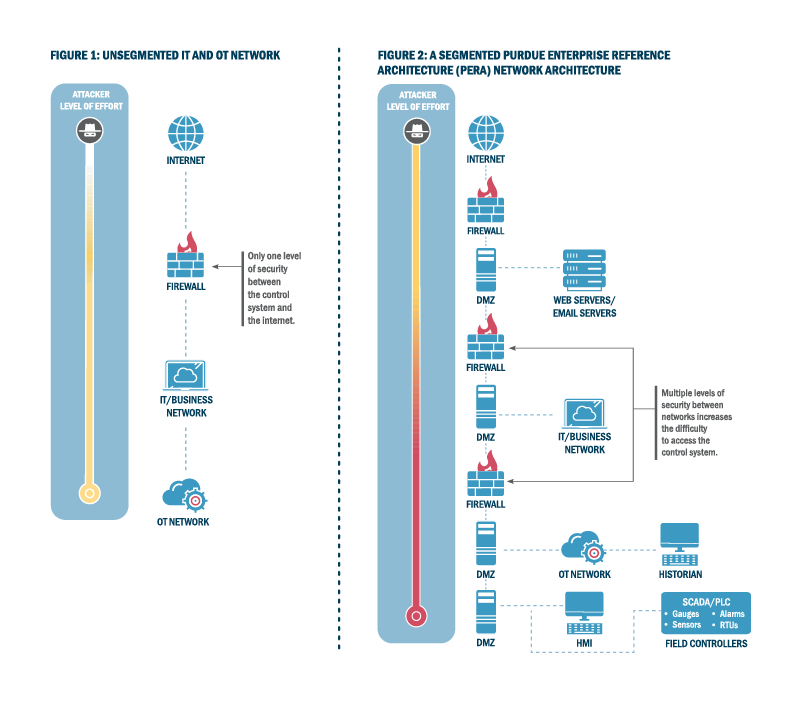
  • DMZ Deployment: A DMZ acts as a secure proxy zone between IT and OT, preventing direct access while enabling controlled data exchange.

What is a Demilitarized Zone (DMZ)?

A secure buffer that separates critical OT systems from external or enterprise networks.

3. Test, Monitor, and Maintain Continuously

  • Validate Controls: Post-deployment testing ensures segmentation functions correctly without disrupting operations.
  • Continuous Monitoring: Track traffic flows and flag deviations or unauthorized access attempts.
  • Ongoing Review: Update policies as new assets or threats arise.

🏆 The Champion Advantage

Effective segmentation requires more than IT knowledge, it demands a deep understanding of industrial processes. That’s where Champion Technology Services excels.

We deliver segmentation strategies that:

  • Protect operations without disrupting uptime
  • Align with CISA guidance and industry specific standards
  • Bridge IT security best practices with OT realities

We combine cybersecurity leadership with control system expertise to design and implement resilient, scalable, and compliant network architectures for critical infrastructure environments.

CISA Recommendations

  • Segment high-value assets into isolated, high-security zones.
  • Use firewalls with specific access control rules.
  • Create a DMZ for critical cross-domain operations.
  • Limit access to DMZ devices through defined user and device lists.
  • Restrict data traffic from OT to IT, particularly for remote access.

Click to see full size.


Let's collaborate.

Schedule a no-cost consultation today.


solution brief

Network Segmentation


More Posts

Read More
Blog

Enhance OT Security with Network Segmentation

In today's increasingly connected operational environments, network segmentation is a foundational pillar for cybersecurity, performance, and system reliability. For industrial facilities managing legacy assets, segmentation isn't just an IT best practice, it's a business-critical strategy.

What is Network Segmentation?

Network segmentation involves dividing a network into smaller, isolated segments (or subnets), each with its own access controls and security measures. This approach:

  • Minimizes the attack surface
  • Restricts lateral movement by threat actors
  • Prevents malware from spreading across the network

6 Key Strategies for Effective Segmentation

1. IT/OT Alignment 🤝

Ensure collaboration between IT and OT teams from the outset. Joint planning, training, and awareness initiatives build shared ownership and improve execution.

2. Identify Critical Assets 🔍

Prioritize protection by identifying which systems are most critical to operations. This enables a phased segmentation approach that minimizes disruption.

3. Network Mapping 🗺️

Visualizing all connected entities reveals data flows, hidden vulnerabilities, and monitoring blind spots—essential for informed segmentation planning.

4. Define Network Zones 🧱

Group systems with similar security requirements into zones, and enforce strict rules for how data moves between them. This zoning model forms the backbone of OT segmentation.

5. Implementation ⚙️

Roll out segmentation in phases to minimize operational risk. Closely monitor performance throughout the rollout to identify and resolve unforeseen issues early.

6. Monitor and Maintain 📈

Ongoing monitoring and regular audits ensure the segmentation strategy adapts to evolving threats. Update protocols and configurations as your network grows or changes.

The Takeaway

As cyber threats grow more sophisticated, network segmentation is no longer optional—it’s foundational. By creating controlled, isolated zones within your OT network, you enhance system protection, simplify compliance, and future-proof your operations for digital transformation.

Let's collaborate.

Schedule a no-cost consultation today.


solution brief

System Hardening


More Posts

Read More
Blog

Navigating New MTSA Cybersecurity Regulations

With cybersecurity threats growing more advanced and persistent, regulatory bodies are raising the bar, especially across critical infrastructure sectors. For facilities covered under the Maritime Transportation Security Act (MTSA), the U.S. Coast Guard is introducing new cybersecurity requirements that demand immediate attention.

As a trusted leader in Operational Technology (OT) cybersecurity, Champion Technology Services is here to guide you through this evolving compliance landscape and help strengthen your organization’s cyber resilience.


What’s Changing with MTSA?

The Maritime Transportation Security Act (MTSA) historically focused on physical security. Recent updates expand its scope to include cybersecurity risk management requirements for MTSA-regulated facilities. These changes reflect increasing attention to vulnerabilities within systems that support maritime operations, including industrial control systems (ICS), SCADA platforms, and connected operational technologies.

Key upcoming requirements include:

  • Integration of cybersecurity controls into Facility Security Plans (FSPs)
  • Routine cyber risk assessments
  • Development of Incident response plans  addressing OT-related cyber events threats
  • Ongoing training and incident response exercises
  • Demonstration of supply chain cybersecurity awareness and risk management

Why It Matters to OT Environments

Unlike traditional IT systems, OT environments often rely on long lifecycle infrastructure and specialized industrial protocols, which can make them more complex to secure and modernize.

OT environments face growing exposure to cybersecurity risks including:

  • Operational disruption caused by ransomware or other malicious activity
  • Targeted cyber activity affecting critical infrastructure sectors
  • Vulnerabilities within industrial control system software and firmware

These updated MTSA regulations highlight a broader shift: OT cybersecurity is now a core component of operational risk management and regulatory compliance.

How Champion Can Help

Champion helps organizations bridge the gap between regulatory compliance and practical OT cybersecurity implementation. Meeting these requirements requires both regulatory understanding and practical OT cybersecurity experience.  Here’s how we can support your MTSA compliance journey:

1. Cybersecurity Risk Assessments

We evaluate your OT environment using standards like NIST CSF, IEC 62443, and USCG directives, identifying gaps and vulnerabilities.

2. FSP Cybersecurity Integration

We update or develop Facility Security Plans to meet evolving Coast Guard expectations—grounded in real-world OT constraints.

3. Secure Network Architecture

Champion engineers design resilient network infrastructures, including:

  • Industrial Firewalls
  • Industrial DMZ architectures
  • Secure remote access solutions
  • VLAN segmentation and network zoning

4. OT-Focused Incident Response

We co-develop incident response playbooks tailored to OT systems—minimizing downtime and speeding up recovery.

5. Training and Simulation

Through hands-on workshops and tabletop exercises, we help OT personnel develop the skills needed to identify, respond to, and report cybersecurity incidents.

6. Managed OT Security Services

Stay protected 24/7 with Champion’s monitoring, threat detection, and vulnerability management—purpose-built for industrial environments.

The Champion Advantage

We bring decades of experience across energy, manufacturing, terminals, and critical infrastructure sectors—where compliance and uptime are non-negotiable. Our team combines deep OT knowledge with practical cybersecurity expertise, ensuring your path to MTSA compliance is structured, practical, and aligned with operational realities.

Final Thoughts

These MTSA updates represent an important evolution in how maritime and industrial operators approach cybersecurity and operational resilience. Let Champion Technology Services help you:

✅ Understand the new rules
✅ Achieve compliance
✅ Build cyber resilience for the future

Champion ready to help you navigate the MTSA cybersecurity requirements with confidence.

Let's collaborate.

Schedule a no-cost consultation today.


more on our website

Industrial Cybersecurity


More Posts

Read More
Blog

Disaster Recovery for OT

In the world of operational technology (OT), a resilient disaster recovery (DR) plan is essential. OT environments are unique, relying on both physical and digital infrastructure, real-time operations, and specialized equipment. A disaster– whether caused by natural events, equipment failures, or cyberattacks– can severely impact these systems, leading to safety risks, production downtime and financial losses.

Unplanned downtime costs industrial manufacturers over $250 million annually.

More Than Just a Plan

A well-planned DR plan can mitigate the impact of disruptions, protect critical assets, and ensure business continuity in the wake of a catastrophic event. However, simply having a plan on paper is not enough. To ensure your DR plan’s effectiveness, it must be tested, regularly maintained, and integrated into your organization's overall risk management strategy.

76% of organizations lack a documented and validated Disaster Recovery plan.

Test and Validate

Regular reviews ensure the DR plan is comprehensive, accurate, and in alignment with the organization’s operations and technology. Further, it can illuminate potential gaps or areas for improvement. Methods include:

  • Tabletop exercises: Simulated disaster scenarios to test the plan's effectiveness.
  • Full-scale drills: Real-world tests involving actual equipment and personnel.

Verify

Verification is the process of testing the backup and recovery systems to ensure functionality is as intended. Elements include:

  • Backup verification: Routine testing of backup processes and files to ensure a reliable recovery path.
  • Recovery testing: Periodic testing of recovery procedures to ensure systems can be restored quickly and effectively.
  • Failover testing: Validate the ability of systems to switch to backup resources in the event of a failure.

Provide Training

Ensure that all relevant personnel, from front-line OT operators to IT staff, are thoroughly trained on their roles and responsibilities in the event of a disaster. This includes understanding the DR plan, knowing how to activate it, and being familiar with the procedures for recovering critical systems and functions.

The Takeaway

A robust Disaster Recovery strategy is not a luxury but a necessity. Remember: it’s not if, but when.

From maintaining safe operations to safeguarding your organization’s reputation to mitigating overall impact, the testing and verification of DR plans is essential to ensure your organization is prepared for challenges that will arise. 

Let's collaborate.

Schedule a no-cost consultation today.


solution brief

Disaster Recovery


More Posts

Read More