
Article

Scalable Strategies for OT Asset Management

More Assets, More Complexity, Now What?

Industrial operations today are not just adding hardware, they’re layering in virtual machines, edge devices, software agents, and cloud connectors. With this growth comes the challenge: how do you manage all these assets reliably, securely, and cost-effectively at scale?

The answer lies in combining monitoring with structured asset management strategies.

Strategy 1: Establish a Baseline with Passive Discovery

Before you can manage, you need visibility.

  • Start with Passive Monitoring tools to automatically detect devices communicating across your network. 
  • Build an initial asset inventory that includes IP, MAC, vendor, model, and firmware.
  • Capture not just what’s online, but what’s vulnerable, misconfigured, or behaving abnormally. 

Tip

Passive monitoring can often be deployed with zero impact to operations and works across diverse platforms.

Strategy 2: Tag & Contextualize Assets 

An inventory without context is just a list.

  • Tag assets with critical metadata—such as control zone, site, function (e.g., HMI,DCS, historian), and ownership. 
  • Link this data with existing sources: CMMS, control system configuration, historian, or network diagrams.
  • Use human-friendly naming conventions and hierarchy to support operational handoffs and audits. 

PRACTICAL STEP

Use spreadsheet imports, CMDB tools, or open API integrations to enrich your inventory without manual re-entry.

Strategy 3: Integrate Monitoring with Lifecycle Planning 

Monitoring tells you what’s happening—asset management tells you what to do next.

  • Leverage performance data to flag aging or underperforming assets.
  • Track lifecycle stages: install date, firmware version, last patch, end-of-support.
  • Schedule reviews for high-risk systems or those approaching obsolescence.

bonus

If you’ve recently migrated to a modern system, start lifecycle tracking from day one to maximize ROI.

Strategy 4: Build Change Management into Daily Operations

Static inventories go stale fast.

  • Monitor for unauthorized changes in firmware, configuration, or IP address.
  • Tie changes to maintenance work orders or authorized updates.
  • Use alerts to notify engineering or cybersecurity teams when anomalies occur.

Scalable Tactic

Focus on key control zones first, then expand visibility zone by zone, prioritize based on risk and asset count.

Strategy 5: Make It Actionable for the Teams Who Need It

The most successful OT asset strategies are ones that are used daily.

  • Build dashboards that serve operators, not just auditors.
  • Align asset groups with how your team works, by process area, shift, or system owner.
  • Offer read-only access to contractors or support teams to eliminate bottlenecks.

TOOLTIP

Integrate with your existing FAT documentation, virtual environments, or support models like our 24UP® Solution, to make data available in context.

Conclusion: OT Asset Management is a Discipline, Not a Project

Scalability doesn’t come from a one-time cleanup, it comes from embedding asset practices into monitoring, maintenance, and modernization. Whether you’re managing 100 devices or 10,000, the right strategy allows your team to grow confidently alongside your infrastructure.

Let's collaborate.

Schedule a no-cost consultation today.


Solution Brief

Asset Management


More Posts
Read More
Project Brief

PCN and DMZ IDC Upgrade

  • The Challenge
Outdated Virtual Environments

Existing datacenter hardware had reached end-of-life, creating limitations in performance, maintainability, and vendor support.

Unscalable System Architecture

The legacy PCN and DMZ systems were built on unupgradable physical appliances, unable to support growing demands or modern applications.

Minimal Redundancy and Recovery

The prior environment lacked virtualization-level failover, reducing the ability to maintain continuity during failures or maintenance.

Unsupported OS and Applications

Critical virtual machines were operating on unsupported platforms, limiting cybersecurity alignment and software patching options.

Mixed Configuration and Oversight

Disparate domain structures and unmanaged system updates posed obstacles to centralized control and consistent operations.

Zero-Disruption Requirement

Upgrades had to be completed without interrupting plant operations, requiring parallel validation and a risk-informed deployment plan.

  • Our Solution
Virtual Infrastructure Modernization

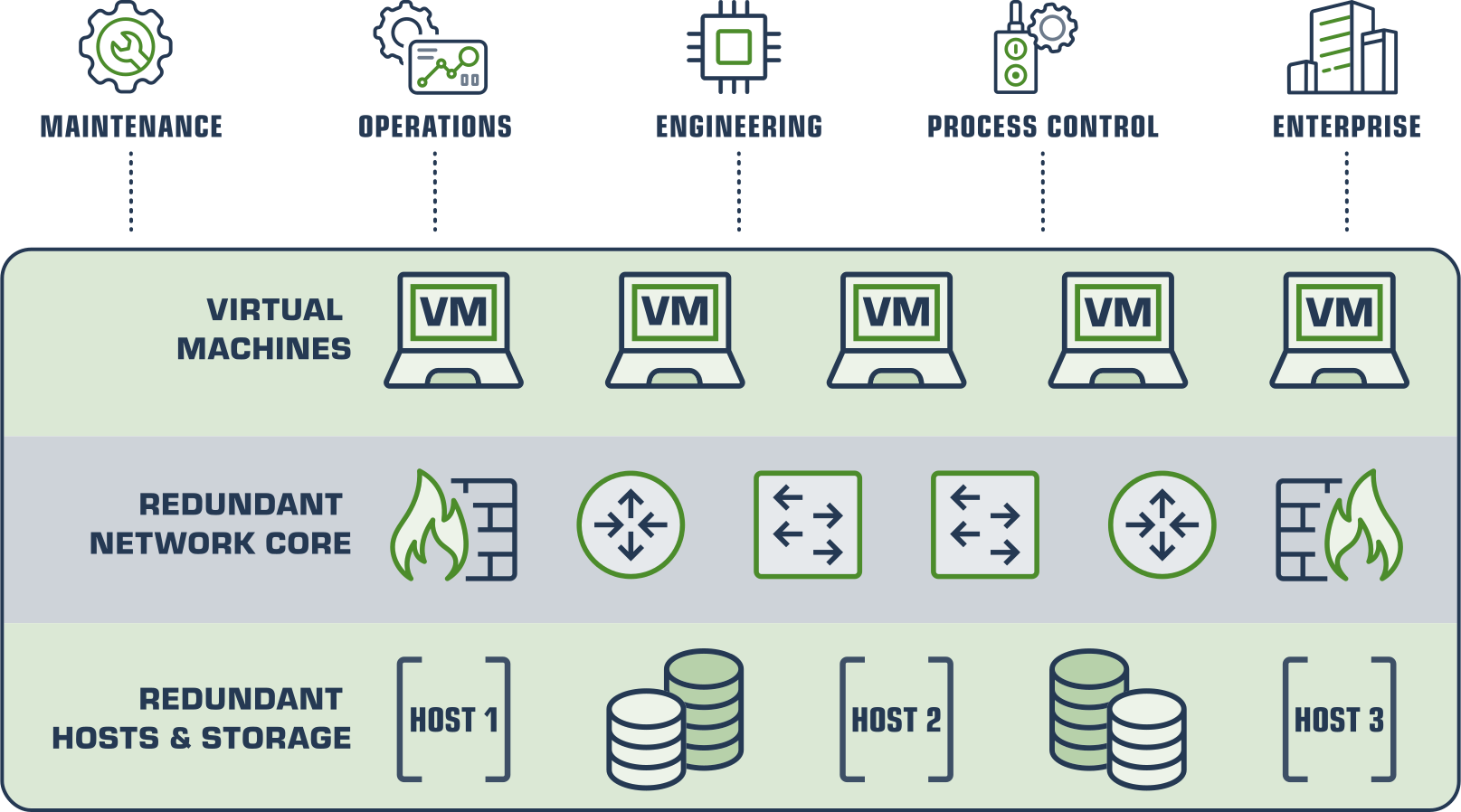
High-availability PCN clusters and standalone DMZ servers were implemented using ESXi hosts and Dell storage arrays, managed via vCenter.

Network Architecture Redesign

Cisco Catalyst switches provided redundant paths, VLAN segmentation, and firewall integration to enhance reliability and zone isolation.

Factory Acceptance & Site Testing

In-house FAT and site SAT validated configuration and failover. Cutover was completed with zero operational impact.

VM and Software Configuration

Over 20 virtual machines were configured to support:

  • Real-time industrial data collection and historian interfaces
  • Antivirus and centralized patching services
  • Rotating equipment condition monitoring and diagnostics software
  • Control system trace and event logging tools
  • Active Directory domain control and backup systems
  • Project Timeline: 8 Months
  • The Results
Improved Uptime

Cluster failover and HA ensure operational continuity and quick recovery.

Stronger Cybersecurity Posture

Supported OS versions, AV/patching agents, and segmented VLANs align with OT best practices.

Streamlined Management

Domain integration, backup validation, and centralized vCenter simplify operations and updates.

Scalable Architecture

The system is designed for future expansion, remote diagnostics, and lifecycle planning.

  • The Champion Advantage
Seamless Integration

Champion delivered a unified virtual infrastructure, covering computer, networking, and virtualization, with end-to-end accountability from design through commissioning.

Client-Centered Execution and Support

From risk-informed cutover strategies to on-site support, Champion aligned closely with operational constraints to execute without disruption to any critical processes.

Future-Ready Foundation

The virtual architecture supports future growth, secure access, centralized patching, and improved OT visibility, positioning the client for ongoing digital transformation.

OT Application Expertise

With deep experience in OT Applications such as historian integration, rotating asset diagnostics, trace/event logging, and OT endpoint security, Champion ensured each application was migrated, validated, and optimized in the new environment.

Smarter Commissioning, Faster Execution

Champion’s structured FAT, SAT, and operator validation approach delivered efficient deployment with confidence in operational readiness.

article

Virtualizing the Future

solution brief

Industrial Data Centers

Read More
Article

Virtualizing the Future

Powering OT Digital Transformation: Virtualization in IDCs

The push for Digital Transformation is reshaping Industrial Operational Technology (OT). It demands greater connectivity, data utilization, and agility. At the center of this evolution is virtualization, and when deployed within a robust Industrial Data Center (IDC), it becomes the foundation for a smarter, more resilient OT environment.

From Siloed Hardware to Agile Infrastructure

Traditionally, OT systems relied on purpose-built physical hardware. This siloed approach, while once effective, now limits integration and scalability. Virtualization, creating software-based versions of computing resources, solves this challenge.

When hosted in an IDC, virtualization consolidates OT applications and even control system components onto shared physical hardware, delivering a more dynamic and manageable environment.

The IDC Advantage: A Foundation for Virtualized OT

Industrial Data Centers are more than server racks. They are mission-critical environments purpose-built to support the demands of virtualized OT systems:

  • Reliable Power & Cooling – Keeps systems running smoothly under consolidated loads.
  • High-Speed Networking – Enables low-latency communication across virtual and physical assets.
  • Security by Design – Protects both virtual and physical layers of OT infrastructure.
  • Scalability & Redundancy – Supports growth while ensuring uptime.

Virtualization: The Engine of OT Modernization

Virtualization within an IDC unlocks new capabilities:

  • Agility and Rapid Deployment
    Provision new OT environments quickly—no waiting on hardware delivery or installation.
  • Resource Optimization
    Run multiple OT applications on fewer physical servers, saving energy, floor space, and costs.
  • Centralized Management
    Streamline backups, patching, disaster recovery, and monitoring—all from a single pane of glass.
  • High Availability and Resilience
    Virtual workloads can move between servers with zero downtime using live migration and fault tolerance.
  • Secure Integration
    Enable safe, structured data sharing between OT and IT systems for analytics and enterprise insight.

Strategic Considerations for Virtualizing OT in an IDC

Successfully deploying virtualization in an IDC requires thoughtful planning:

  • Workload Suitability – Not all OT workloads are ideal for virtualization. Prioritize based on performance and latency sensitivity.
  • IDC Readiness – Ensure the data center has the power, cooling, and connectivity to support virtualized workloads.
  • Virtualization Platform – Choose a platform with industrial certifications and robust support for OT systems.
  • Network Segmentation – Properly isolate OT systems to maintain security and regulatory compliance.
  • Expertise and Integration – Work with partners like Champion Technology, who understand both OT requirements and data center architecture.

Looking Ahead: OT’s Virtual Future

The combination of virtualization and Industrial Data Centers is rapidly becoming the backbone of future-ready OT operations. It enables organizations to:

  • Modernize aging infrastructure
  • Enhance security and availability
  • Reduce physical and energy footprints
  • Accelerate time-to-insight through data integration

As industrial environments grow more connected and data-driven, embracing this strategic shift isn’t optional—it’s imperative.

Our team helps OT leaders modernize with confidence. Our expertise in virtualized infrastructure and control system environments makes us a trusted partner for your Digital Transformation journey.

Let's collaborate.

Schedule a no-cost consultation today.


Solution Brief

Industrial Data Centers


More Posts

Read More
Project Brief

Industrial Data Center Upgrade

  • The Challenge

Legacy data center hardware had reached end-of-life, limiting system reliability, scalability, and vendor support options.

Obsolete Windows environments prevented the application of critical patches and updates, impacting compliance and system stability.

Outdated versions of FactoryTalk and historian software introduced performance bottlenecks and integration challenges with modern platforms.

fragmented domain and workgroup configuration made it difficult to enforce consistent user policies or manage authentication centrally.

Limited VLAN segmentation reduced network visibility, increased broadcast domain congestion, and created barriers to secure zone management.

The absence of high-availability mechanisms and VM mobility increased risk during maintenance windows and system transitions.

The migration needed to occur without interrupting operations, requiring a carefully sequenced cutover plan and parallel runtime verification.

  • Our Solution

Both data center environments were rebuilt with fully virtualized, high-availability platforms. Core control system applications, historian nodes, and Windows services were migrated to domain-managed virtual machines for greater scalability and centralized control.

Switching infrastructure was upgraded to support segmented VLANs for management, storage, and control traffic. Routed failover between sites provided redundancy and improved network performance.

OT applications including FactoryTalk View SE, Linx, Alarm & Event, and Historian services were upgraded to current versions. Engineering and operator workstations were refreshed with pre-configured toolsets for faster deployment and user readiness.

A structured deployment approach included Factory Acceptance Testing (FAT), parallel HMI validation, and a staged cutover. Snapshot backups and rollback procedures ensured system continuity throughout.

  • Project Timeline: 6 Months
  • The Results

The modernized OT systems delivered key advantages. Redundant systems ensured uptime and operational continuity, while network segmentation and supported platforms strengthened cybersecurity. Centralized control simplified management, and modern infrastructure provided fast recovery and failover.

Sed egestas, ante et vulputate volutpat, eros pede semper est, vitae luctus metus libero eu augue. Morbi purus libero, faucibus adipiscing, commodo quis, gravida id, est. Sed lectus. Praesent elementum hendrerit tortor. Sed semper lorem at felis. Vestibulum volutpat, lacus a ultrices sagittis, mi neque euismod dui, eu pulvinar nunc sapien ornare nisl. Phasellus pede arcu, dapibus eu, fermentum et, dapibus sed, urna.

  • The Champion Advantage
Seamless Integration

A unified solution across virtualization, networking, and software eliminated the need for multiple vendors.

Client-Centered Execution and Support

Staged cutover, clear documentation, and on-site training ensured a smooth transition with minimal disruption.

Scalable and Future-Ready

The upgraded infrastructure supports digital growth, remote access, and enhanced OT visibility.

Smarter Commissioning, Faster Execution

Champion’s risk-informed approach, with FAT, SAT, and operator validation, enabled efficient deployment and handoff.

Sed egestas, ante et vulputate volutpat, eros pede semper est, vitae luctus metus libero eu augue. Morbi purus libero, faucibus adipiscing, commodo quis, gravida id, est. Sed lectus. Praesent elementum hendrerit tortor. Sed semper lorem at felis. Vestibulum volutpat, lacus a ultrices sagittis, mi neque euismod dui, eu pulvinar nunc sapien ornare nisl. Phasellus pede arcu, dapibus eu, fermentum et, dapibus sed, urna.

Ready to elevate your operations?

article

Securing Legacy OT Systems

solution brief

Disaster Recovery

Read More
Article

Industrial Data Centers: Digital Foundation to Drive Innovation

Data has become the digital fuel that powers modern industries. From manufacturing to energy, efficient data management is crucial for optimizing operations, improving decision-making, and ensuring reliability. Industrial data centers serve as key infrastructure components, supporting companies as they transition to Industry 4.0.

What is an IDC?

Industrial data centers (IDCs) are specialized, integrated systems that combine computing and network infrastructure, storage solutions, and power management with OT software and data management tools. They provide a highly secure and scalable environment for data storage, processing, and analysis, empowering industries to derive valuable insights and drive innovation.

Key characteristics of IDCs include:

Integration of OT and IT Systems: IDCs often house systems that bridge the gap between operational technology (OT), such as sensors, control systems, and machinery, and information technology (IT) systems, enabling real-time data collection, processing, and decision-making.

Real-Time Data Processing: Industrial environments often generate vast amounts of data in real-time. IDCs are designed to handle and process this data efficiently, ensuring timely insights for process optimization, predictive maintenance, and system reliability.

High Availability and Reliability: Given the mission-critical nature of industrial operations, IDCs are built to provide high levels of uptime and redundancy to avoid disruptions that could lead to costly downtime in production processes.

Edge Computing Capabilities: Industrial Data Centers often incorporate edge computing to process data closer to the source, reducing latency and enabling quicker decision-making, especially in scenarios where immediate responses are needed, such as in automated production lines or power grids.

Support for Industry 4.0 Technologies: As companies adopt Industry 4.0 technologies like IoT, AI, and machine learning, IDCs play a vital role in storing and processing the data these technologies generate to drive smart manufacturing and automation.

The Takeaway

IDCs deliver the critical infrastructure needed to support digital transformation and digitalization initiatives, enabling industries to maximize the value of their existing systems and assets.

By ensuring high availability, security, and scalability, IDCs empower industrial facilities to optimize processes, reduce downtime, and harness data-driven insights to drive innovation and remain competitive in an increasingly connected and data-centric world.

Let's collaborate.

Schedule a no-cost consultation today.


Solution Brief

Industrial Data Centers


More Posts

Read More
Article

Digitalization: The Future of Industry

A global digital revolution is underway, disrupting industries and reshaping our world at an unprecedented pace. The industrial and critical infrastructure sectors are no exception.

What is Digitalization?

Digitalization is the integration of digital technologies to automate processes, optimize workflows, and achieve operational excellence. Gartner describes digitalization as “the process of moving to a digital business.”

This means connecting machines, systems, and people through a digital network to collect, analyze, and utilize data for improved decision-making. Successful digitalization facilitates innovation and creates sustainable value.

Technology and Trends Driving Digitalization

Cybersecurity Enhancements

With the increasing connectivity of OT systems, cybersecurity measures have become critical to protect against cyber threats.

Impact: Advanced cybersecurity solutions, such as anomaly detection and threat intelligence, help secure OT environments from attacks like ransomware and other forms of cyber intrusion.

Industrial Internet of Things (IIoT)

Integration of sensors, devices, and machinery with internet connectivity, enabling the collection and analysis of real-time data.

Impact: IIoT enhances operational efficiency, predictive maintenance, and real-time monitoring, allowing companies to optimize processes and reduce downtime.

Edge Computing

Edge computing processes data closer to the source (i.e., at the edge of the network) rather than relying on centralized cloud computing.

Impact: Reduces latency and enables real-time decision-making for more reliable and secure data processing in OT environments.

Artificial Intelligence (AI), Machine Learning (ML)

AI and ML technologies analyze vast amounts of data to identify patterns, make predictions, and automate decision-making processes.

Impact: AI/ML drives advancements in predictive maintenance, quality control, and process automation, leading to more efficient and reliable operations.

Advanced Data Analytics

Data analytics tools process and analyze large volumes of operational data to provide insights and support decision-making.

Impact: These tools improve operational efficiency, reduce waste, and help in the identification of trends and potential issues before they become critical.

What’s Next in Digitalization

The future of digitalization holds boundless potential for innovation and growth in OT environments driven by the convergence of IT and OT. Enhanced data analytics and the integration of cyber-physical systems, along with a focus on sustainability, will lead to more autonomous, efficient, and secure operations, further enhancing the resilience and adaptability of OT environments.

By harnessing the power of emerging digital technologies, businesses can achieve significant improvements in efficiency, productivity, and competitiveness with those embracing digitalization leading the way.

Let's collaborate.

Schedule a no-cost consultation today.


more on our website

Digital Transformation


More Posts

Read More